




Humility in Love

Humility in Love

Have you ever thought about how loving yourself (which is commanded when Scripture several times says to love your neighbor as yourself) is actually an incredibly humble stance in life? Let me repeat that. Loving yourself is humble.

Here’s why I think so—I think you can only love yourself when you see who Jesus made you to be, and start to accept the love He has for you. Love is demonstrated, and He demonstrates this love all the time. The danger comes when we try to perform or deserve love. We try to measure our worth by what we do or how “good” we are. God doesn’t love us because we have measured up to a standard in some way. In fact, He says we all fell short of the standard. And yet. He still chose to love us.

When we fail over and over, we assume that God will get sick of us sometime. The problem is that He didn’t start with loving us because of our successes. He loved us before we loved Him—before we could see Him as anything but an enemy. He calls to us in love constantly, regardless of our behavior.


Rediscovering Joy Through God's Loving Gaze, by an Anonymous Counselee

Rediscovering Joy Through God's Loving Gaze, by an Anonymous Counselee

I never expected joy to be something I would have to go searching for. I grew up hearing that Christians should be joyful, that joy was something you choose, that joy was the proof that God was near. But somewhere along the way, joy became a word that didn’t feel connected to my actual life. I tried to smile, tried to be grateful, tried to be strong — but inside there was a quiet ache I couldn’t name.

This book was born out of that ache. Out of years of striving. Out of carrying shame without knowing that’s what it was. Out of feeling unseen, overwhelmed, and unsure of how to “choose joy” when everything inside me felt too tired to rise.

But then God met me in a way I didn’t expect — not with instruction, not with pressure, not with disappointment — but with a tender, lifting hand. With a voice that whispered, “Look up… let Me hold your face… let My delight be the truth you see.” It broke something open in me — something I didn’t even realize was still bracing for disappointment, still hiding behind downward eyes, still afraid to be seen.

The Sacrifice of Trust as Worship

The Sacrifice of Trust as Worship

A lot of things have not gone the way I hoped or expected this week, and I found myself frustrated and stressed. Usually when I have those emotions, it’s because I have decided I need to control a situation and I’m realizing that I can’t. I was talking to God about all of it, pouring out my worries, my fears and my feelings with all of it. His response has been similar with many things recently—Do you trust me?

I realize that often I don’t. Trust can actually be a sacrifice, as I’m laying down my plans, my way, my time and my illusion of control in order to receive His peace. What I want is an answer, a solution. But often what He invites me into is placing all of my cares in His hands as He tenderly cares for me. This is trust.

What He began to show me this week is how trusting is part of worship. It is saying that He is God and I am not. It is saying that I trust Him to be who He says He is, and to empower me to be who He made me to be as well. As we walk forward in sorting through the practical problems, we do it together. He never abandons me to just figure it out on my own. I do have to lay down my own way of doing things, though, for the better way He has.

Learning Contentment

Learning Contentment

I have been thinking about how Paul talks about “learning” contentment and being “trained” in the secret of overcoming all things in Philippians 4:11-13. Sometimes I have some sense that I’m supposed to just know how to be content, and then there is much self-criticism when I’m not. But I like Paul’s take on it—we get to learn contentment.

How do we learn it? By being trained in seeing things differently. Jesus keeps reminding us of who He is, His strength and power within us to accomplish anything. He also reminds us of who He has made us to be—conquerors in Him. But we don’t see these truths often when we are covered up by fear, worry, doubt and general discontentment with our lives.

I recently learned the meaning of the word “yadah” in Hebrew. The word means “give thanks” but not in a trite, flippant way. It implies the thrusting of hands up in worship, and is often used when people in the Old Testament are in the middle of a mess. Jonah uses it when in the belly of the whale, David when in danger, and others when they have not seen the victory or deliverance yet. There is a sacrifice that comes with praise, especially when you don’t feel like praising God in the middle of the difficulty.

Being Needy

Being Needy

I was having a moment last week where I finally cried out, saying “I’m so needy!” And God’s response was so gentle—I love needy people.

Dependence is never criticized when it comes to relationship with God. He loves it when we walk in dependence and trust in Him. Sometimes we make ourselves needy for other people or circumstances to change, but this doesn’t bring the desired result. Other people won’t be able to meet our needs, and change in circumstances is only temporary. Instead, we can come to Him when we are weary, heavy-laden and desperate.

He will not receive us with disappointment as we might expect. Instead, He welcomes us with open arms and holds us close to infuse us with rest and peace. God loves to bring us close when we will let Him do so.

God of the Last Minute

God of the Last Minute

God of the last minute, the rushed, the unplanned.
Thank you that you don’t get stressed.
You aren’t wondering how to get through.
You see the whole, and yet know we see only the part. 

Thank you for your patience with me
As I freak out a little and wonder why.
Thank you that you’re always ready
For me to run to your everlasting arms. 

Thank you that I haven’t messed it up--
I know I don’t have that much power.
That you are always bringing reversals
When we least expect or hope for them. 

Life from death, hope from despair,
Flowers from ashes, joy from pain,
Peace from chaos, freedom from chains,
A Shepherd in the valley of the shadow of death. 

He is Faithful

He is Faithful

I started this week with regret. I had such a busy weekend, and didn’t have the prayer time throughout the day that I like to remember. I felt stupid—like I had failed God because I didn’t have conversations with Him over the weekend like I usually do. And I told Him I was sorry. His response was so beautiful—I am always faithful. Just come. Leave regret and guilt behind and come to me. I have never left.

So often I feel my relationship with Jesus depends on my meeting a set of standards and expectations I have for myself. I think that when I fail to meet these, I am failing Him and He might leave me or reject me because I’m not doing enough. That’s an enormous amount of pressure, especially for someone who messes up all the time!

But over and over again in Scripture and in my life, Jesus has proved Himself faithful even when people are faithless. He remains consistent, even when we are angry or rejecting of Him. He remembers us even when we forget.

Identity and Relationship

Identity and Relationship

Some days I feel like a one-string banjo player—I just keep talking about the same thing over and over. But I know that this is what God has equipped me for, and continues to empower through me. My repetition? Your identity in Christ and deepening relationship with Him no matter what the circumstances. Some might question why I keep harping on these things.

Why is your identity in Christ so important? Because most of the stupid choices we make or the things we try to fill our lives with are because we have no idea who we are. We try to make sex our god, using others and letting them use us with no idea of what we are worth outside of physical appearance. We live at the top-level of stress because of a career we believe defines us, all while terrified that we might not have identity without it. Things get really dicey when we retire or lose a job. So many of us are constantly thirsting for acceptance and love, believing if we could just find the right combination of satiation we would be filled up.

Instead, I want to wake people up to who Jesus calls them—beloved, accepted, worthy, known, heard, remembered, complete, lacking nothing, purposeful, forgiven, valued. And all of this is based in who He is, so we can’t mess it up. If you don’t know who you are and have tried to figure it out through all sorts of different means, stop and ask Him right now. He loves to tell His kids how much He adores them.

Learning to Listen

Learning to Listen

When I was in grad school, I had a teacher who taught a class called “Counseling Skills” or something to that effect. I kind of rolled my eyes when I realized I had to take that class, because I had the arrogance to believe I knew how to listen, how to care, and how to communicate compassion already and didn’t need a class to help me. The lesson in humility, though, was not given through the class material itself, but by the professor. This man walked in to talk to a bunch of new students who were all prospective counselors, and approached with such gentleness it stopped me in my illusions of grandeur and made me pay attention.

In thinking back to this kind man, I realize that he taught me how to listen because he actually listened in class. Sure, he taught the lessons, but then he would calmly entertain questions and treat each student with such value and worth that you instantly felt like you mattered—even if your question was really stupid. He never looked like he was trying to come up with an answer while listening, but would take the question with a minute of consideration so he could truly take in everything the person was saying.

I came to find out throughout the semester that this man was dying of cancer. He didn’t tell us, but once in a while when he would have to miss class, the substitute informed us that he would be doing that occasionally when he didn’t feel he could have enough strength to teach. And yet, there was never a demand for respect or honor, but a continued communication of his students’ value as he approached with gentleness. I watched him deteriorate throughout the semester, and attended his funeral the next year after he went to be with Jesus face-to-face. I remember thinking how it must feel for him to be present with the One his soul loved so much, and who had always listened to him.

Kingdom Perspective

Kingdom Perspective

What does it mean to seek first the kingdom of God when you don’t want to get back into performance or legalism? That’s a question I’ve been pondering a lot recently. Jesus says to seek first the Kingdom and His righteousness in Matthew 6, but as with so many things in Scripture, we’ve taken this to mean that we have to generate the Kingdom ourselves and our performance is graded to see how well we are seeking.

The context of the verse is in relation to pursuing or being obsessed with provision—food, clothes, etc. Jesus says instead of being fixated on what you might need or think you need, to run after His reality. This isn’t just in heaven, as in Luke 17:20-21, Jesus says the Kingdom of God is already expanding among some of those around Him. And Romans 14:17-18 says that the Kingdom isn’t a bunch of rules about eating and drinking, but rather the realm of the Holy Spirit. And serving Jesus by walking in the kingdom realities was pleasing to God.

Fearing the Future

Fearing the Future

God has been talking to me a lot about fear this year, as you can probably tell if you’ve read any of my blog posts from the last few months. I have realized that we tend to do one of three things with fear:

1.        Obsess on it, thinking we are protecting ourselves or preventing something from happening by having control (an illusion) and coming up with all the worst-case scenarios. We sometimes believe that knowledge and information will help, but without any power we are devoid of actually keeping our fears at bay and they control us.

2.        Ignore it, believing somehow that if we face it head-on that will bring it into reality. Of course, this is similar to hiding from the monsters under the covers—I might not see them, but it wouldn’t do much in the way of protecting me from anything scary. Denial is just lying to ourselves, believing that we will not have to face anything we fear or anything difficult.

3.        Entrust and release it to God, believing that He can free us from it and allow us to walk through anything because of His strength within us. This isn’t an attempt at control or denial, but rather trusting Jesus to be with us and walk with us through whatever the fear is. He actually can free us from the fear, rather than continuing to spin round and round in it.

Moving Past Understanding

Moving Past Understanding

I was listening to a man several years ago who had just lost his infant daughter in the two weeks after she was born. She had fought for life, barely hanging on for those weeks, and then never left the hospital in her physical body. I attended the funeral with the tiny casket at the front, and, with tears pouring down my face,  watched her brothers, mother and father celebrate the brief life of their little girl. Months later, the man was talking to a ministry board and was asked how he was surviving. His answer has stuck with me to this day.

The grieving father said that when he was operating from his soul—his mind, will and emotion—he felt like he was cracking apart. He couldn’t make sense of anything that had happened (least of all why God had allowed it). He couldn’t fix it or force something to happen to change the outcome. And he felt raw, blinding grief that sucked joy away replacing it with anger and deep sadness. He said that in his soul, he couldn’t find what he needed.

Instead, he had to move into his spirit, which was filled with the Holy Spirit. His spirit could acknowledge reality above the physical one, and find comfort in what God spoke to him there. The earthly reality didn’t change, and his grief wasn’t gone. But he was able to move into a deeper part of him that brought peace.

Aspen Trees and Impossible Situations

Aspen Trees and Impossible Situations

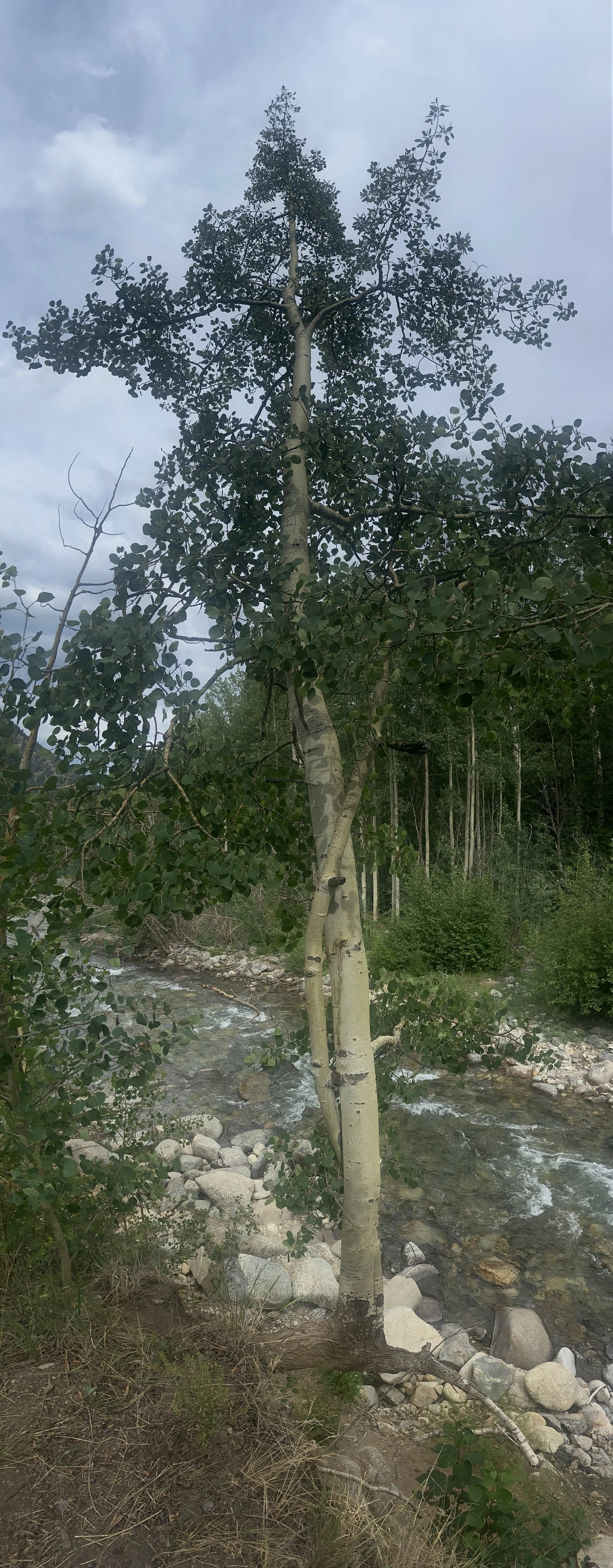
Last week we were camping in the mountains, and I came across the most crazy-looking aspen tree. From a distance, it looked completely normal, healthy and thriving. The leaves were green and plentiful, and it was even supporting a smaller aspen growing up with it. I walked right up to the river bank on which it was growing, looked over the edge and was stunned by what I saw. Below the aspen tree, it’s roots were suspended in the air as it grew out of the bank and looked like it was almost floating. I couldn’t understand how it could continue to thrive when the base of it looked so precarious.

Of course, this got me thinking about how this relates to people, because God often teaches me about people through nature. First, we never know what is going on in people’s lives, but we often judge and compare based on the externals. I can’t tell you how many times I have to tell myself how little I know rather than jumping to conclusions about what looks perfect or compare-worthy on the outside. We don’t know what a person’s root system looks like, and sometimes make judgements without understanding.

Second, I know God is teaching me so much about His perspective versus mine when it comes to my circumstances. I look at that tree and tell it that it should probably give up based on the root system being suspended in the air! But it wasn’t, and even more so, it was living as if it was perfectly rooted and supported by the dirt. Yet, based on what I know about aspen tree root systems, it was actually being supported by all the other aspen trees around it by being joined together underground.

Why Should I Be Afraid?

Why Should I Be Afraid?

I was watching a show the other day that follows a free diver, aptly named Ocean Ramsey, as she dives with sharks and promotes a different perspective on these animals. One of the marine biologists who commented on her advocacy said that Ramsey jumped into the ocean and asked a question—why should I be afraid? This was one of those gut-punching questions for me, as I considered how often we run away or never jump into places that we have been taught are scary because we have never asked this same question. Now, whether or not you agree with Ocean Ramsey’s quest to change the world’s opinion on sharks, I would ask you to look at your life and consider asking the same question about some of the other areas you might shy away from because it seems dangerous, stupid or downright crazy.

Something about fear is really important to God as He talks about it a lot in the Bible. He has not designed us for fear, but He knew we would experience it. Sometimes fear displays as anger, control or anxiety. But often we don’t stop to ask the question—why should I be afraid?

Often in Biblical stories, people push into circumstances that seem incredibly scary, something they maybe shouldn’t do if they are being “reasonable.” But they are operating in the identity God has given them and they are walking the calling He has given them, so the question is answered. There is no reason to walk in fear because they are made for this, and they have a God who is strength in weakness. David and Goliath, Gideon and the Midianites, Esther and Haman, Paul and the Romans—none of these people ended up running from fear but pushed directly into it. I know that some took some convincing, but ultimately they walked in places that they naturally should have been afraid, recognizing that supernaturally and spiritually they were going to be okay.

A New Perspective

A New Perspective

One of the things I’ve always loved about traveling is how my perspective shifts. I get outside my comfort zone and walk in someone else’s path—not their shoes, but at least I see a different way of living or thinking. I don’t want to lose that willingness to shift perspective and listen long enough to at least have a small understanding of someone else’s way of doing life.

I am realizing that a lot of our relationship with God is about changing our perspective as well, and starting to receive God’s instead. I think prayer is entering into a conversation with God and allowing Him to shift our perspective—to think differently about whatever situation is in front of us, and to accept that what we can see may not be the whole picture. We are invited into life that surpasses anything we could have imagined.

This is why when we try to anticipate beauty from ashes, or all things being worked together for good, we get a little stuck. We can’t see how its possible because we don’t have the perspective that God does. I love that not one thing in this world can defeat what God is doing in us. I meet so many people who feel they can never amount to anything because of what has happened in their lives or what they have chosen. Yet that is never God’s perspective. He sees who you are the whole time, and nothing can change or alter that. He is making you to become who you already are, which means your identity is already true, and there is also a process of revelation as He shows you who He is through you more and more.

Will You Jump?

Will You Jump?

Our dreams as children of being athletes, astronauts, doctors, superheroes or princesses seem to hit a giant wall somewhere in adolescence as we are told they are impossible, require too much money, require too much school or aren’t going to lead us to a successful life (whatever that is defined by someone who is older and wiser at the time). Instead of paying attention to what these dreams tell us about ourselves, we shut them down and tell ourselves to toe the line and be conformed to the formula of what our culture dictates is our future. That might mean making lots of money, having a marriage and family, being powerful in society, or any other number of definitions that spell success in our culture’s eyes.

I wonder, though, where we listen to God in all of this. The Bible is full of stories of people who were given an identity by God but didn’t believe it. They tried to fit into the identity that society was giving them, which really was just believing the fear when it told them they couldn’t make it. I know that sometimes I get stuck listening to the “wisdom” of the world and dismissing any thoughts of following some of the crazy things God might be calling me to do.

Be Still

Be Still

When the world is spinning and feels like you are in a tornado,
When the stress ramps up and starts to choke you.
When the pain of loss and grief threatens to drown you in tears.
When the overwhelm and anxiety threaten stagnate you in everything today.

Be still. Know that I am God.

When I can’t figure a way out of the mess I’ve created.
When rejection is close and the fear of more governs my relationships.
When my finances are bleak and the outlook bleaker.
When I watch my loved ones hurt and hurt each other. 

Be still. Know that I am God.

When I feel like I’m moving through mud as everything is in slow motion.
When I can’t make things stop as they spiral and whir by my eyes.
When all of the plans I had made fall apart and wither away.
When I can’t see a future or a hope, and feel that the painful present is all there is. 

Be still. Know that I am God.

God's Great Reversals

God's Great Reversals

What do we do with pain? I really believe we only have two options, although the way these present can look different. The first option is to allow it to control us, whether by trying to deny or ignore it, or by focusing on it entirely and allowing it to tell us who we are. The second option is to allow God to bring life from death, creating the Great Reversal in our lives.

When we decide that we are no more than our pain, it controls us. It tells us we are worthless, rejected and hopeless. We believe it, and receive messages from whoever caused this pain in our lives. We basically allow these people who have done damage to completely define us, and thus continue to have power over us. We may be in complete denial of the way the pain has affected us, but it still controls us. It’s sort of like a dry drunk—instead of continuing to focus on alcohol by drinking it, the focus is on alcohol but abstaining from it instead. The obsession is still there, and the addiction still controls.

If we are trying to explain away our pain or pretend it’s not there, we live as a distortion of ourselves. We want to believe that we are free, but having never faced the pain and pushed through it, we continue to be controlled in a different way. I can tell you how many people I talk to who still believe messages that were given to them by rejecting or abusive people 30, 40 or 50 years ago. If we never recognize who is speaking these lies, we assume they might be true because they are in our heads and run freely in our thoughts.

A Posture of Receiving

A Posture of Receiving

Many times in circles of Christ-followers, we obsess on what we are doing “for” God and how much we are producing, trying desperately to make Him happy with us. I find this stems from an incorrect concept of God, one who is angry and sets unrealistic standards for us, waiting to punish us when we don’t measure up. This is not the God I see in Scripture, as He pursues people constantly to lead them to repentance. Repentance is a change of mind, a turning that leads behavior. God is always walking with you, but repentance means you recognize it and ask Him for His perspective. Sin is separation from God. As Mike Wells used to say, “You fall out with God before you ever fall into sin.” But we obsess on sin as the problem, rather than a break in relationship with Jesus being the problem.

If we are constantly trying to measure up to whatever standards and expectations we believe are important, we basically become just like the religious leaders of Jesus’ day, whom He warned against often. They ended up demonstrating their hatred for God when they crucified Him. They would not be led to a change of mind, but were determined to follow the rules they had set for themselves and to judge everyone around them who was not measuring up in their view. It became a competition among the religious leaders to see who could be more religious. Interesting, isn’t it, when we sometimes do the same thing in the body of Christ?

Over and over again, Jesus told people that He had come as the Savior because we all needed one. That means that we couldn’t save ourselves. We couldn’t come to relationship with the Trinity because we kept trying to achieve and appease instead of receive. We often continue to make it about behavior rather than heart.

Bringing Fear to the Light

Bringing Fear to the Light

I have been reading a book recently that has made me think deeply about my greatest fears. (It’s Living Fearless by Jamie Winship in case you want to read it. I highly recommend!) Most of the time in the past, I try to push fear away, just telling myself to deny it and move on anyway. I think it’s sort of like when you are a child and you hide under the covers from the monsters in your closet—we believe that will keep us safe from the things we fear. Denial becomes the bed covers, and we keep hiding under it hoping that the fear will go away.

Instead of this, though, Jamie recommends confessing fear to Jesus and letting Him free us from it. I have to be honest, when I first read this, I still really struggled with the idea. I don’t want to talk about my fears. But then I also realized that God already knows my fears, so it’s no surprise or disappointment to Him. I haven’t achieved anything in terms of being free of fear by ignoring or denying them. Instead, I spend a lot of time trying to stomp them down again, hoping they will go away if I just muscle them into submission.

So, I was walking and thinking about this, and I finally took the mental barrier down to really bring my fears out and discuss them with Jesus. And in the spirit of vulnerability opening up vulnerability in others, I’m sharing them with you too.